Expectations vs. reality
Going in, the focus was twofold:
- Get a sharper understanding of the technical direction of AI-related modules
- Strengthen relationships with the broader leadership group
Both boxes were checked, but what stood out most wasn’t just technical clarity. It was the level of alignment (and sometimes misalignment) across contributors trying to move in the same direction.
A community navigating new territory
What stuck most was the sheer passion of the contributors.
The Drupal ecosystem is entering unfamiliar territory. Instead of a single organization driving innovation, we’re now seeing multiple companies collaborating under a shared vision for AI in Drupal. That’s powerful, but it’s also complex.
Coordination at this scale isn’t easy. And yet, the energy and commitment across the board make it feel not only possible, but inevitable.
Key moments and conversations
A clear highlight was the keynote by Dries Buytaert.
It didn’t just inspire, it clarified. It set a strong North Star for where Drupal is heading in an AI-driven world.
Another moment that resonated was the discussion around “contribution vs. cantribution.” The idea is simple but important: if you’re contributing AI-generated code, you should fully understand it.
There’s a real tension here. AI is accelerating development, but it also raises valid concerns about quality, ownership, and responsibility. The fact that this debate is happening openly is a good sign. It shows a community actively shaping its future rather than passively reacting to it.
Unexpected insights
One of the more surprising themes was the growing importance of digital sovereignty, especially among US-based organizations.
In several conversations, particularly within the education sector, concerns around the Cloud Act and reliance on hyperscalers kept coming up. There’s a clear shift toward exploring alternative hosting strategies that provide more control and independence.
It’s a nuance that’s becoming harder to ignore, and one that will likely influence architectural decisions moving forward.
The AI tipping point
If there’s one overarching trend, it’s this: AI has crossed a threshold.
With the release of Claude 4.6 Sonnet, the perception of AI has fundamentally changed. What used to feel like a helpful assistant for autocomplete is now a serious development accelerator.
The difference is noticeable:
- Better code quality
- Fewer hallucinations
- More reliable outputs
It finally feels like AI is operating at a professional level, and that changes everything.
Excitement… and concern
There’s no denying the excitement. But it comes with an undercurrent of uncertainty.
Many in the community are asking the same question: what does this mean for our roles, our skills, our future?
It echoes the broader story of technological shifts throughout history. Adaptation is inevitable, but it’s rarely comfortable.
What’s encouraging is that these concerns aren’t being dismissed. They’re being discussed openly, which is exactly what a healthy open-source community should do.
Ideas worth exploring
One concept that stood out was the Context Control Center.
It has the potential to become the backbone of Drupal AI, connecting features, enabling extensibility, and creating a unified system rather than a fragmented landscape of modules.
If executed well, this could unlock a level of synergy we haven’t seen before in Drupal.
The value of hallway conversations
Some of the most valuable moments didn’t happen in sessions.
Conversations with people like Kristen Pol and Aidan Foster offered deeper insights than any slide deck could. These informal exchanges are where ideas get tested, refined, and sometimes completely reshaped.
Where we stand
From a Dropsolid perspective, there’s a lot to feel confident about.
We’re ahead in our commitment to a unified approach. Instead of scattering efforts across countless disconnected modules, we’re focusing on building something coherent and scalable.
Where we can improve is speed to value.
There’s a clear opportunity to introduce AI Recipes, preconfigured, reliable setups that allow users to quickly enable high-quality AI features without complexity. It’s about delivering immediate impact, not just long-term vision.
So… what now?
Interestingly, the biggest takeaway wasn’t a pivot.
It was validation.
The direction we’re heading in is the right one. The challenge now is execution, maintaining momentum, and turning the vision into tangible results.
Final thoughts
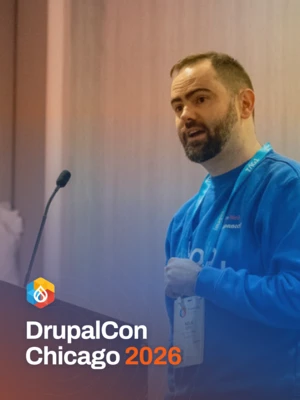
The atmosphere at DrupalCon Chicago was unique.
A mix of nostalgia, celebrating 25 years of Drupal, and a forward-looking intensity shaped by AI’s rapid evolution. It created a space that felt both reflective and urgent at the same time.
And yes, it was absolutely worth it.
Not just for the insights, but for the alignment.