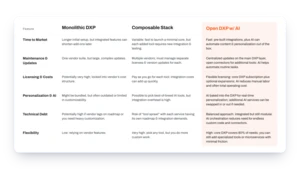
From this table, the Open DXP with AI stands out as a balanced solution. You don’t pay for a fully monolithic suite you might not fully use, nor do you manage a tangled web of separate systems.
Why drupal is the perfect base for an AI-Driven open DXP
At the heart of many Open DXPs is Drupal, a leading open-source CMS. Why Drupal?
Modular architecture
- Entities & Fields: Perfect for structured data; AI-driven personalization thrives on well-structured data.
- Extendable: Contributed modules for personalization, analytics, and marketing automation are abundant—many already AI-compatible.
Vibrant community
- Fast innovation: New modules appear quickly, including AI integrations. See the Drupal CMS project/product. Enormous effort delivered in only 8 months.
- Long-Term support: Thousands of contributors ensure Drupal stays secure, modern, and relevant.
API-first
- Easier AI integration: Drupal’s REST and GraphQL interfaces make bridging to AI microservices seamless—no hacky custom code needed.
- Decoupled potential: You can run a decoupled front-end with React or Vue, while letting Drupal handle the data and AI orchestration behind the scenes.
For a deeper dive, check out the Drupal docs on composable DXP integrations.
Dropsolid experience platform: Our optimized open DXP and hosting/devops platform with AI
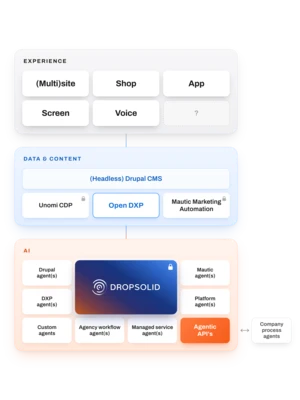
At Dropsolid, we advocate for an Open DXP approach enhanced by AI. That’s why we built the Dropsolid Experience Platform, a platform combining:
- Drupal at the Core: The world’s most flexible open-source CMS for robust content management.
- AI Layer: Tools like Dropsolid AI for automated personalization, content recommendations, advanced analytics, and intelligent DevOps.
- Integrated marketing automation: Pre-configured or optional tie-ins with Mautic or other marketing automation providers.
- Freedom to extend: If you have custom e-commerce or a specialized microservice, you can integrate it without re-architecting the entire stack.
Result: You get an “out-of-the-box DXP”—faster time to market, core AI-driven features—and the composability to tailor the platform to your unique needs.
How AI enhances the open DXP approach
- Automated content & devOps
- AI writes initial drafts, suggests images, or even runs continuous performance tests.
- Deployments can be orchestrated with minimal manual intervention, freeing developers to focus on strategic tasks.
- Real-Time personalization
- Segment visitors based on on-site behavior, location, or past interactions. AI then adapts content blocks, calls to action, or product suggestions dynamically.
- Predictive insights
- AI digs into visitor data, anticipating churn or cart abandonment and prompting marketing automations to re-engage those users.
- Reduced maintenance overhead
- Because the DXP is integrated, AI can manage updates across the platform rather than you having to patch each service individually in a purely composable model.
Conclusion: The future is hybrid, open, and AI-driven
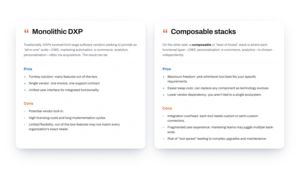
In a world of extremes — fully monolithic DXPs versus fully composable stacks — Open DXP with AI offers a powerful balance. You get:
- Speedy onboarding akin to monolithic solutions, without the heavy lock-in or crippling licensing fees.
- Composable flexibility so you can adapt or extend features as your business grows or market conditions shift.
- AI-Driven efficiency that automates personalization, DevOps, and analytics to keep your digital experiences state-of-the-art.
At Dropsolid, we’ve built our Dropsolid Experience Platform precisely for this future. If you’re curious about how an AI-powered Open DXP can elevate your digital strategy—whether you’re coming from a purely composable approach or a legacy monolith—reach out to us. We’d love to show you why this balanced model is the best of both worlds.