
Lessons from the latest Driesnote: AI has raised the floor. Who raises the ceiling?

At DrupalCon Chicago 2026, the Driesnote sent a clear signal about Drupal's place in the AI era and, more importantly, about where enterprise teams should focus their attention.

DrupalCon Chicago: Driesnote

At DrupalCon Chicago 2026, the Driesnote sent a clear signal about Drupal's place in the AI era and, more importantly, about where enterprise teams should focus their attention.

Here is the short version: AI has raised the floor. Average work (functional, adequate, unremarkable) is now fast and cheap. That is not a threat to skilled teams. It is a shift in where the value lies.

If ‘average’ is free, depth matters more, not less. The question we should ask ourselves is not: "will AI replace our team?" The question is: "who raises the ceiling?"

driesnote dropsolid

The ceiling belongs to expertise

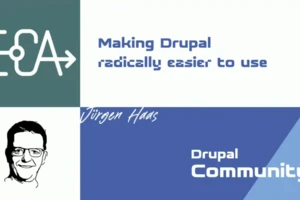
At the end of his Driesnote, Dries showed a striking example from the past year. Jurgen Haas is a core contributor to ECA, the Event-Condition-Action module that drives complex automation workflows in Drupal. In six weeks, he delivered a significant set of features: in-place automations and a visual debugger. Work that would normally take considerably longer.

Not because an AI wrote the feature and then left. But because Jurgen used AI to remove the mechanical parts: the scaffolding, the repetitive patterns, the parts where the solution is known and typing is the bottleneck. What remained was the part that requires years of experience: architectural judgement, design decisions and trade-offs that only make sense if you understand how ECA actually works at system level.

The floor rose. Jurgen raised the ceiling.

This is the model that deserves attention. The concern that AI flattens the value of hard-won technical knowledge is real, but it applies to average knowledge, not to expertise. When AI handles the mechanical part, deep expertise becomes the differentiator. You are not competing with AI. You are the person AI works for.

driesnote

The same dynamic at organisational level

What applies to an individual contributor also applies to enterprise teams, but with higher stakes and a more costly failure scenario.

Generic AI is fast and directionless. It produces output that sounds confident, but lacks actual institutional knowledge. No brand voice, no legal frameworks, no audience definitions, no decisions on content architecture that took years to shape. At small scale, that is an irritation. At enterprise scale, it is a risk.

The Context Control Center (CCC), announced during the Driesnote and now in beta, addresses this directly. It anchors AI output in your organisation's actual knowledge: brand guidelines, content personas, SEO strategy and legal context. The CCC doesn't make the model smarter. It makes the AI output yours: governed, contextual and auditable. Without this system, you get fast output for no one. With it, you get something your editorial team can truly rely on at scale.

This is the difference between a pilot that works in a demo and a production system your team can use for three years without having to rebuild it.

The rails are not a constraint, they are what makes speed possible

Dominique puts the underlying architecture question clearly: Drupal is the track the AI train runs on.

Without a structured content layer, AI hallucinates. It doesn't know your brand strategy, your compliance requirements, or which terminology your legal team has approved. Drupal's entity model, field-level structure and configuration management provide the schema that makes AI reliable at scale. The structure is not a constraint on speed; it is what makes speed sustainable.

At Dropsolid AI, this is the architecture we are building: Drupal as the governance and context layer, AI as the acceleration layer. Not a generic AI product stuck onto a website, but an opinionated stack where every part does what it was actually built for. The CCC brings institutional knowledge to the surface. Drupal structures it. AI operates within those boundaries.

With AI alone, you can prototype something convincing. You need the Drupal architecture, and the governance it provides, to build something that holds up in a production environment.
Quality means ownership of what you deliver

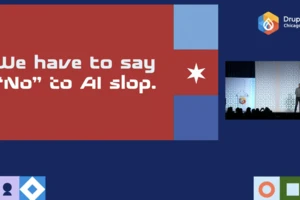
During the Driesnote, Dries Buytaert put it crystal clear: no AI slop. That is not a complaint about AI. It is a statement about ownership. And after everything above, it lands as a confirmation, not a warning: if AI raises the floor, people are responsible for raising the ceiling.

That takes more than just prompting. Jurgen's six-week delivery was credible not only because AI sped it up, but because Jurgen understood every line. He reviewed it, critiqued it and took ownership of what was delivered. The speed only works when the person steering it can tell the difference between good output and plausible-sounding output.

At Dropsolid, this is the design philosophy behind everything we do and deliver. The rails, the Context Control Center, the governance layer: none of it exists to slow AI down. It exists so that a human is accountable for what AI produces. Experts are not removed from the process. They become the quality guardians. AI produces faster; the expert decides whether it is good enough to go live.

What enterprise teams should be asking themselves now

The Driesnote in Chicago confirmed what we see across all our enterprise projects: the AI implementations that hold up are not the ones with the most advanced models. They are the implementations where context is defined, content is structured and governance is designed before the first output is generated.

AI raises the floor. Your architecture, your context and your expertise determine how high the ceiling goes.

If your team is struggling with these questions (how AI fits into content operations, what governance looks like at scale, how to move from prototype to production), come and talk to us. We'd rather have an honest conversation about your architecture than sell you something you don't need.