You may have wondered: “How do you make sure the user experience on your website is as good as possible?” Well, testing usability, better known as usability testing, provides an answer. In this blog post, I briefly explain how to improve the usability of your website and get a better user experience as a result.
The first impression of your website counts
You only have 5 seconds to make a good impression with your website, make it count! Your website is the first point of contact between your company and the customer, so it must have maximum impact. Visitors often already have certain expectations of what they hope to find on your page. Several techniques can help you meet those expectations.
One of these techniques was already explained in the blog post about user experience by our colleague Amandine. Another is improving the usability of your website. The earlier you measure the usability of your website, the sooner any errors come to light. That way, you easily avoid big costs.
You only have 5 seconds to make a good impression with your website, make it count! Your website is the first point of contact between your company and the customer, so it must have maximum impact.
What is usability testing, or the ‘usability’ of your website?
Usability is becoming more and more important as organisations compete in ever-changing online markets. Usability is an umbrella term for the productivity, or ease of use, the usefulness and the functionality of your website. The better your website scores on these three factors, the better the user experience. So what does this mean in concrete terms? Simply put: meeting the expectations of your users and making their search as easy as possible.
Now, what are possible usability problems that lead to a poor user experience?
- bugs or errors,
- an overly complex structure and information architecture,
- too much ballast for a visitor to complete a task,
- text that the visitor thinks is clickable but actually contains no hyperlink,
- no logical set-up, for example when filling in a form, the structure of your navigation,…
If your website does not meet your customer's expectations, they will look for another site that does meet their needs. That is why a usable website is so important. Five factors show that usability is crucial to the success of your business:
- A usable website focuses on a user-centred approach. And that is exactly what matters enormously in these modern times.
- The more usable your website, the more attractive it is for visitors to stay on it, and so the lower your bounce rate.
- Your user achieves their goal efficiently and is satisfied with the search process. They don't feel they have lost ‘time’.
- A usable website has a (direct or indirect) positive effect on your visitor's purchase intent.
- ‘Simplicity’ is the golden rule for a usable website. Ease and time savings are two critical factors that contribute to optimal usability.
These factors therefore have an impact on your ROI. The better the user experience, the more loyal your visitors. So it pays to meet these expectations and make your user experience as good as possible. But how exactly do you go about it?
‘Simplicity’ is the golden rule for a usable website. Ease and time savings are two critical factors that contribute to optimal usability.
How does Dropsolid improve the usability of your website?
We do this through usability tests or usability testing. With these tests, we evaluate both the functionality and the design of your website or web application, through targeted actions and observations of your users. The big advantage is that we actively involve end users in this research. That way, we gather insights into what people really do on your website, rather than relying on assumptions.
- Define the target group: all users are important, but you can never survey them all.
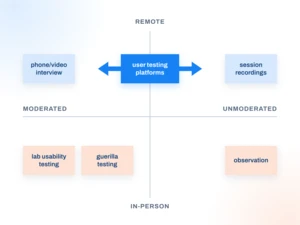
So it's best to narrow down your target group for this research, depending on your budget, your objectives, the time and the resources needed. - The type of usability test: you choose a (un)moderated, remote or in-person test.
There are many different types, depending on your research goal, budget and time. - Scenario plan: we briefly outline the situation for the tasks to be performed.